 octopusgames
Experiment 02 — Learning the Landscape
This is a representation experiment alongside the preserved V4 navigation benchmark. It investigates Appearance → Features → Semantics → Relations → Learned Place Representation. It does not replace the live V4 navigation solver or rebrand a matching score as probability.
Fixed protocol · Raw JSON · Evaluation CSV · V4 event-level audit
The earlier conclusion needed one correction
V4's semantic ablation did not change any of the twenty estimated positions, and aggregate success stayed at 17/20. But it changed all twenty scores and two acceptance decisions:
| Recorded event | Full learned Hybrid | Semantics removed | Same position error |
|---|---|---|---|
| Seasonal, 36 s | Accepted, score 0.460 | Rejected by geometry gate, score 0.496 | 0.401 m |
| Seasonal, 84 s | Rejected below score threshold, 0.382 | Accepted, score 0.497 | 2.138 m |
The successful fix lost at 36 seconds and gained at 84 seconds cancel in the aggregate. Thus semantic evidence did affect the decision boundary, but contributed no net success gain in that replay. The earlier aggregate-only description was too broad. This distinction is visible in the unaltered raw-data audit.
V4 memory changed only two estimated positions and five scores, with no acceptance changes. That explains the small 0.0477 m mean improvement without implying a general failure of learning.
What constrained V4
Hybrid's global retrieval was appearance-led and detailed local pose search used NCC before its combined certificate. Geography could change candidate ranking and acceptance but could not fully recover places excluded from the three-candidate shortlist. The image extractor supplied generic material components and modest relations; the latent world's landmark identities were correctly unavailable to the matcher. Class agreement alone did not identify a unique place.
The old memory retained observed descriptors and could propose candidates, but immutable historical imagery still controlled final verification. It had no aggregated stable geometry or conditional appearance model. Replaying exactly the same seasonal frames established a measurable retrieval-proposal effect, not unseen-observation generalization.
New representation, with information boundaries preserved
place-graph.js derives camera-centred, nominally canonical metre coordinates from pixels. Nodes describe measured material components. Edges retain pair distances, bearings, orientation relations, building layouts and observed road/water adjacency. One-to-one correspondence estimates a common similarity transform. Verification needs three inliers and two supporting relations. Two points that can always be perfectly aligned do not count as sufficient verification. Missing observed structure is negative candidate evidence; structure absent from the observation contributes no information.
The graph does not receive Bridge B17 or River R4 labels from the latent world. Road/water adjacency is not asserted to be a bridge. Its geographical reach is limited by the approximately 96 m footprint and the image extractor: rich river curvature, full road-network topology and long-range cross-view identity remain limitations.
place-memory.js groups only externally verified estimated positions. Stable node identities use one-to-one association in estimated world coordinates; edges bind to those identities. Running means and variances describe geometry. Bounded appearance variants preserve condition-specific observations; condition records retain support, score and residual statistics. Query geometry is scored against those learned distributions, not merely against the most recent image. It is still an engineered estimator, not neural representation learning.
Exact acquisitions remain deduplicated even after their appearance variant is evicted. Replaying an image cannot increment independent support indefinitely. Training admission uses the frozen memory-free V4 solver, the 0.55 score gate, geometry and 2σ innovation. “Independent” here means independent of learned memory; it is not an independent physical sensor or a guarantee of correctness.
Interpreting information gain
All methods operate on the same 532-cell reference lattice. We normalize explicit composite compatibility weights and report their entropy in bits, effective candidate count 2^H, and candidates carrying 95% of mass. We also measure true-cell rank, true-cell log loss and mass within 32 m of the true position. Truth enters only this final evaluator.
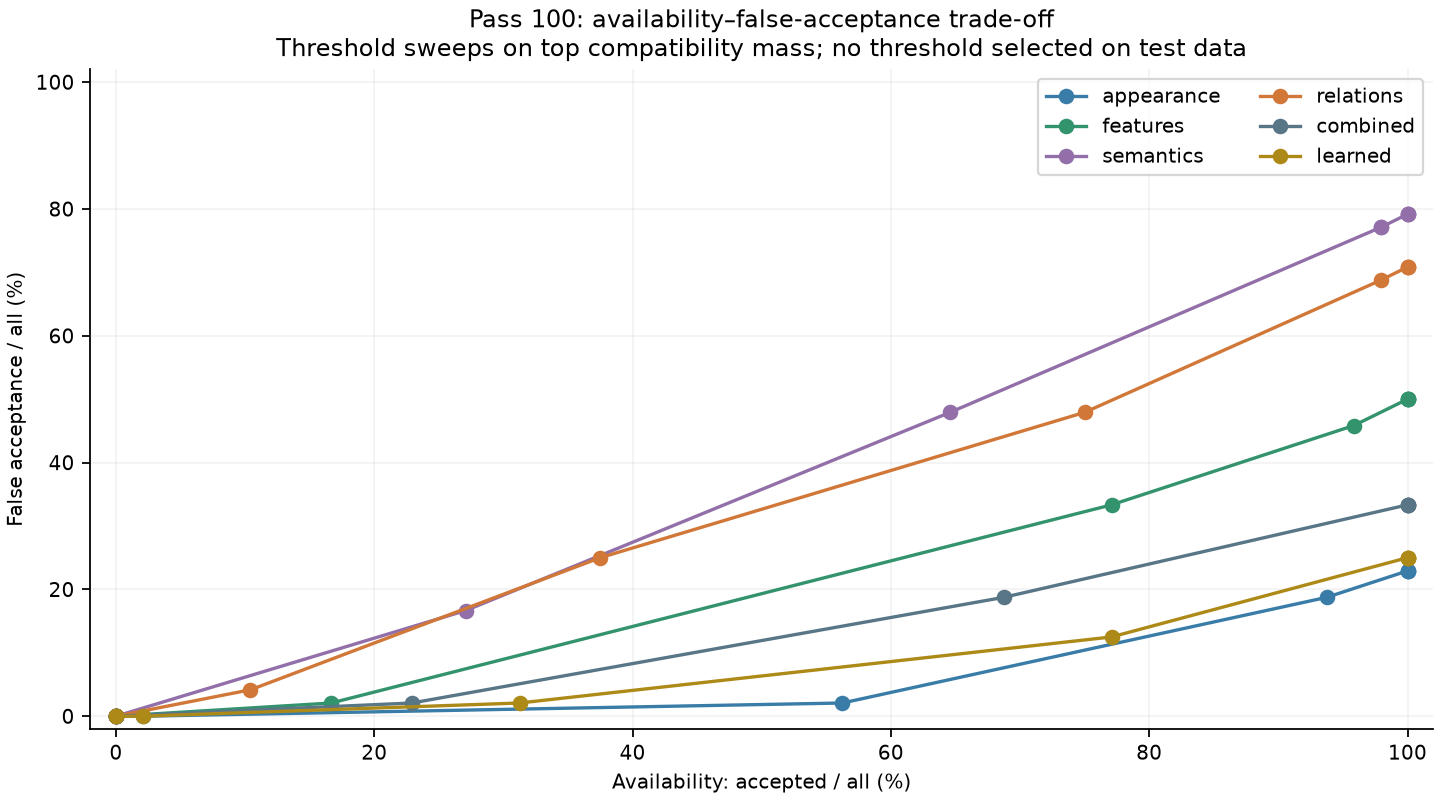
These weights are not calibrated probabilities, and H(prior)−H(updated) is a model-dependent entropy reduction, not experimentally established mutual information. Adding evidence may increase entropy. A narrow distribution centred on the wrong place is a failure. The geometric-filter trace reports no verified candidate when none pass, rather than inventing a single survivor.
Place retrieval within 32 m and true-cell log loss are different measurements from V4's accepted final-pose error within 10 m. The methods in this isolated experiment should not be compared numerically to V4 as if their tasks or solvers were identical.
Measured learning results
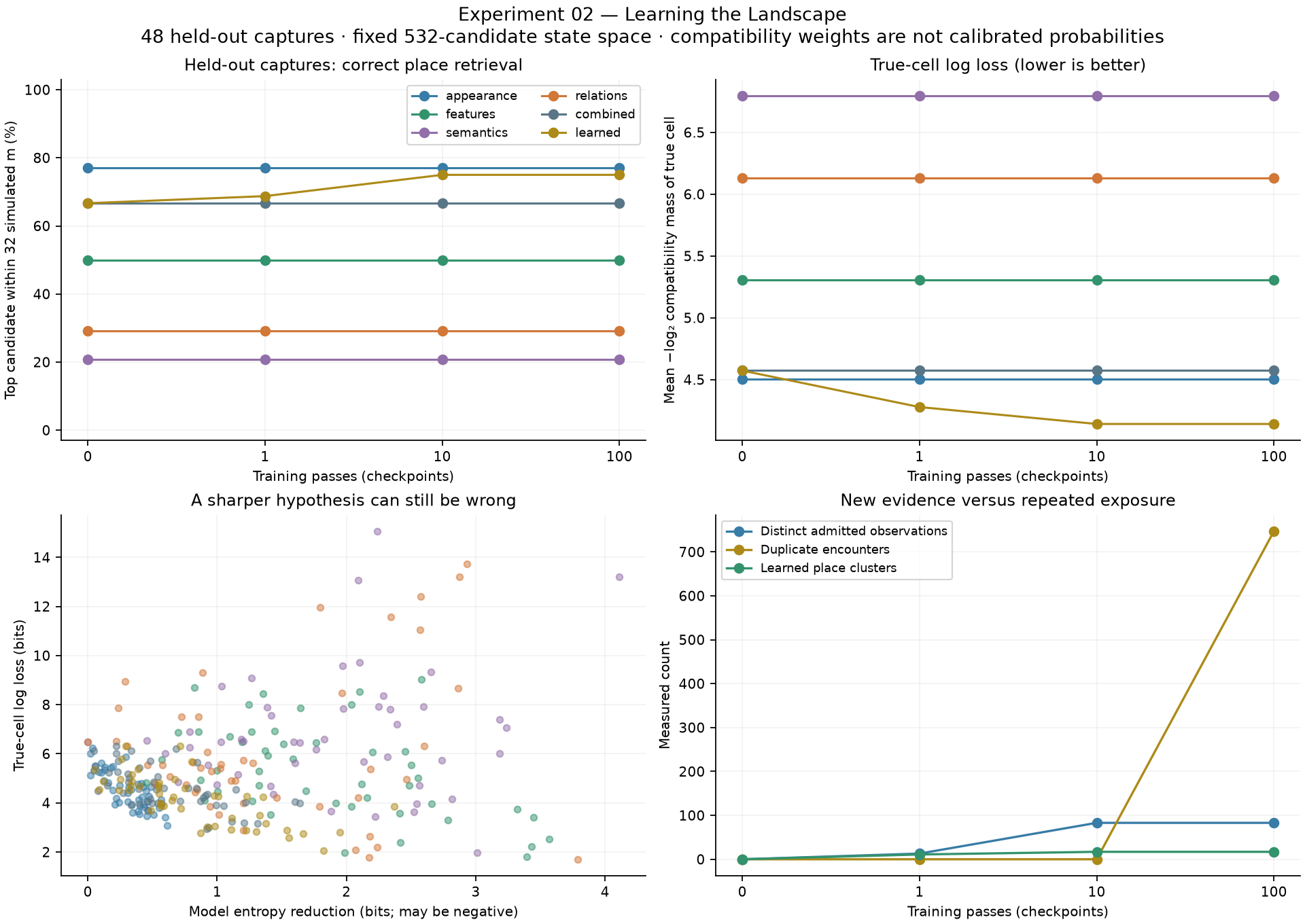
The frozen run used seed 20260919, 2,000 training encounters and 200 distinct training images, followed by 2,112 checkpoint/method evaluations of 48 held-out captures. These captures use different timestamps on the same route and world. The new method performs place retrieval on a fixed lattice; it does not claim metre-level final pose accuracy.
| Pass | Distinct admissions | Places | Correct places / 48 | Mean candidate error (simulated m) | True-cell log loss (bits) |
|---|---|---|---|---|---|
| 0 | 0 | 0 | 32 | 44.723 | 4.573 |
| 1 | 13 | 11 | 33 | 43.886 | 4.278 |
| 10 | 83 | 17 | 36 | 38.846 | 4.141 |
| 100 | 83 | 17 | 36 | 38.846 | 4.141 |
Learning improves the combined model from 32/48 to 36/48 correct places (66.7% → 75.0%). Mean candidate error falls from 44.723 to 38.846 simulated metres. This is evidence of adaptation to unseen captures within this synthetic world, not proof of general world-model learning.
There is no improvement from Pass 10 to Pass 100. This is expected in the pre-specified repetition control: passes 11–100 contain no new images. All 747 repeated admissible encounters were deduplicated. The 83 distinct admissions had zero evaluator-audited errors above 10 m; 79 appearance variants remained after bounded retention. Across all repeated attempts, 1,170 gate rejections were counted. The learned representations and predictions at Pass 10 and Pass 100 are identical.
This plateau tests evidence accounting. It is not an empirical claim that learning saturates after ten independent seasons. Studying continuing learning would require a new arm with genuinely novel acquisitions beyond Pass 10.
Does learned geometry actually contribute?
| Pass-100 representation | Correct places / 48 | Mean error (simulated m) | True-cell log loss (bits) |
|---|---|---|---|
| Appearance only | 37 | 28.770 | 4.504 |
| Semantic counts | 10 | 103.082 | 6.795 |
| Relational graph | 14 | 75.625 | 6.133 |
| Combined, no learned memory | 32 | 44.723 | 4.573 |
| Combined with relations removed | 34 | 43.603 | 4.767 |
| Full learned place representation | 36 | 38.846 | 4.141 |
| Learned geometry removed | 35 | 39.449 | 4.189 |
| Learned appearance removed | 33 | 44.043 | 4.516 |
| Learned representation without prior | 30 | 119.762 | 6.500 |
Removing learned geometry reduces success from 36/48 to 35/48 and worsens true-cell log loss from 4.141 to 4.189 bits. It changes the top hypothesis in three cases; in test:baseline:79, geometry changes the candidate error from 54.21 m to 22.99 m, crossing the 32 m place threshold. Another changed case has slightly worse candidate error while remaining inside tolerance. Geometry now has a measurable marginal contribution, but it is small.
Removing learned appearance gives 33/48. Appearance coverage still contributes most of the measured improvement. Raw relational graphs improve on semantic counts (14/48 versus 10/48), but remain weak. Adding those relations to the unlearned combination reduces top-place success from 34/48 to 32/48, while improving true-cell log loss. They redistribute useful mass without consistently choosing the right mode.
Appearance alone still gives 37/48 correct places and lower candidate error than the full learned representation. The learned model has lower true-cell log loss. These are distinct trade-offs, not an overall-winner result. The coarse retrieval implementation of local features is also different from V4's detailed pose-refined feature solver; its lower retrieval result is not a reversal of V4's algorithm benchmark.
When information reduction is actively misleading
In test:growth:3, effective candidates fall from 157.8 to 2.0 after graph evidence and the geometric filter. Yet the final candidate is 490.7 simulated metres away. The true cell falls from rank 14 in the prior to rank 274 after the filter, and its 32 m neighbourhood receives zero mass. Geometry retained two wrong candidates. This is a failure of representation and verification, not a successful information gain.
In test:baseline:63, river and road/water adjacency reduce effective candidates from 140.1 to 3.2, but the top candidate is still 67.5 m away; the true cell ranks second. Additional relations and geometry increase entropy again. The trace intentionally preserves this non-monotonic behaviour.
Across the 48 held-out frames, semantic counts produce a wrong top place with positive entropy reduction in 37 cases; relations do so in 33 cases. The learned combined model still does so in 12. Its separate high-mass wrong-mode flag (top mass ≥0.5) is zero; this does not mean wrong concentration is absent at lower mass. Both diagnostics are exported.
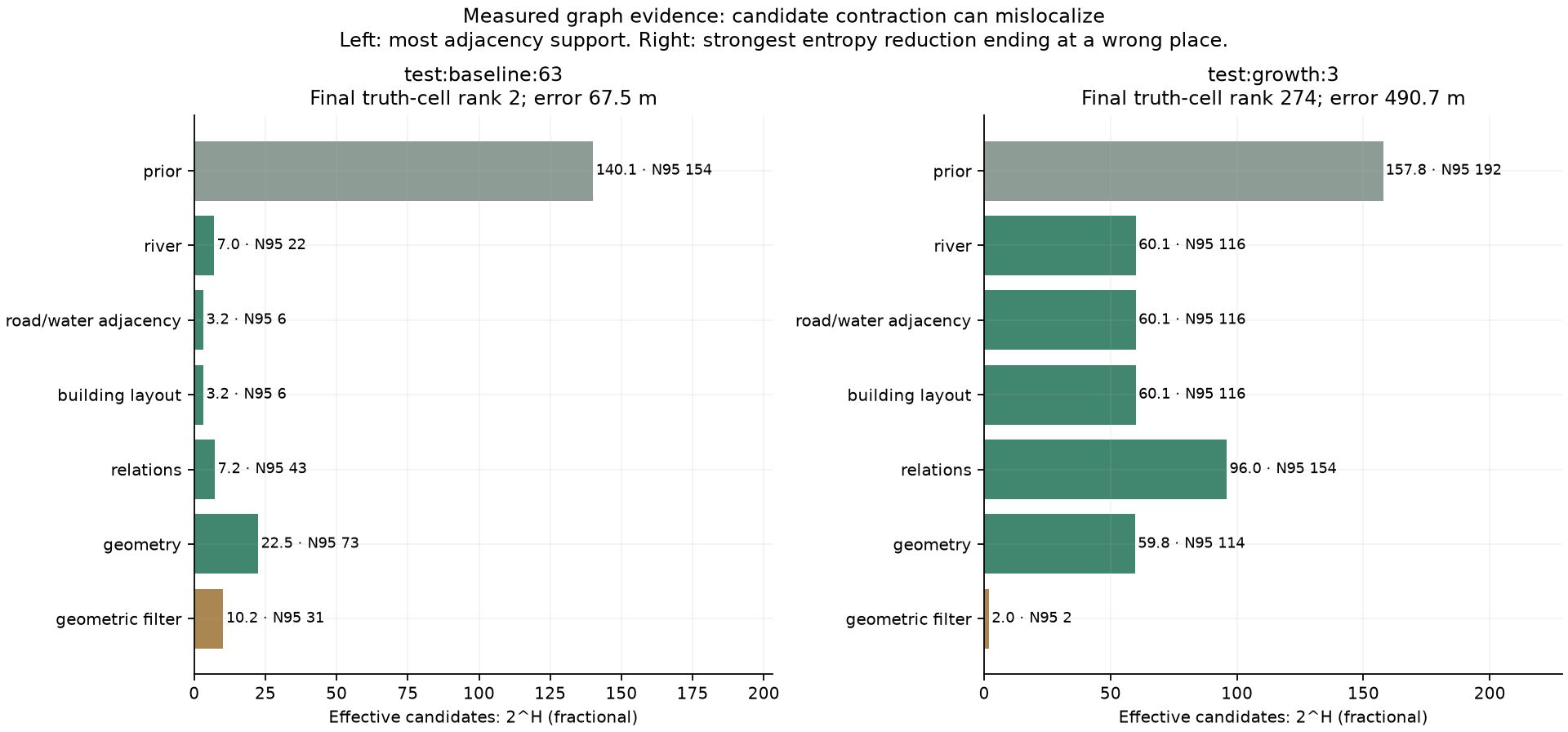
The plotted counts are 2^H and can be fractional. They are not hand-written survivor counts. N95 is the measured number of lattice cells carrying 95% mass. The final filter's actual pass count is also in each raw trace. The label crossing in the JSON is a compatibility-channel key for observed road/water adjacency, not a confirmed bridge detector.
What the model has learned, and what it has not
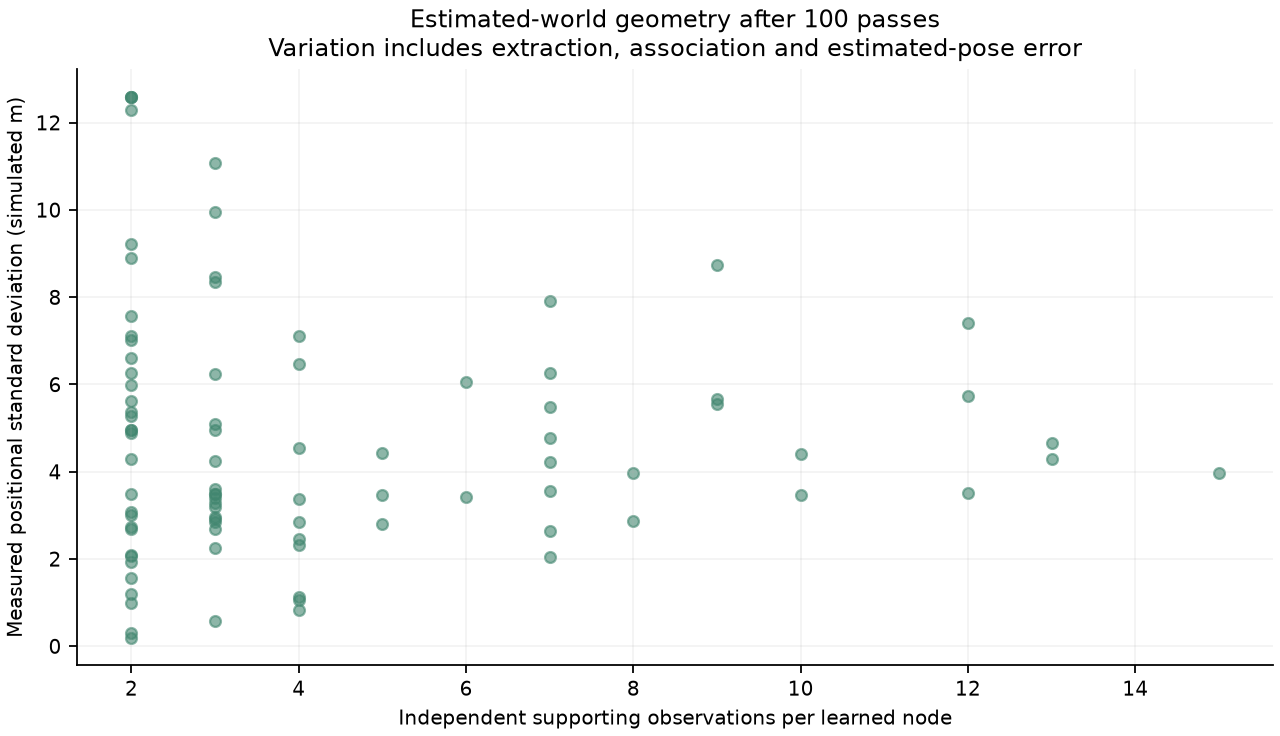
Place snapshots expose conditional appearance variants, estimated-world node/edge means and variances, and empirical per-condition support/score/residual statistics. Some repeatedly supported nodes remain variable by several metres. Such variation combines material-extractor changes, association mistakes and estimated-pose error; more support does not automatically mean more correct geometry.
The results support a limited conclusion: this memory can improve held-out place retrieval and learned geometry can alter some decisions. They do not establish robust semantic identity, reliable bridge recognition, a calibrated posterior, a learned physical world model, or transfer to real sensor telemetry. The same belief/observation/residual pattern can motivate a digital-twin experiment, but Navigation Lab results do not validate another domain.
Reproduction and limits
- Protocol and fixed weights
- Raw records, candidate traces and learned-place snapshots
- Evaluation CSV
- Frozen experiment source bundle
- Learning PDF, information PDF, trade-off PDF, geometry PDF
- Artifact validation
The source bundle includes the executable experiment, module tests, rendering dependencies' lockfile, and frozen protocol. Run npm ci, node scripts/run-landscape.mjs, then node scripts/verify-landscape.mjs. Node v26.4.0 and native Canvas 1.0.9 were used. Rendering/runtime changes can change fine pixels. Timing is host dependent; cached encoding/graph work is not a fresh per-algorithm localization latency measurement. The current export combines capture, extraction and candidate matching under evidenceMs; finer per-stage timing is not available. Log loss uses a numerical mass floor of 1e-300 for zero-mass cells.
All 51 automated tests passed; the final entropy numerical-tolerance change also passed its three targeted tests. The complete run passed twelve source-hash checks, preserved all seven V4 core hashes, and verified train/test image disjointness, identical evaluation images per method, and exact Pass-10/100 prediction equality. The existing desktop/mobile research view also passed browser checks. The new experiment is exposed as reports and figures; the live navigation UI keeps the V4 solver. Its displayed confidence label is now “Matching score” / “Acceptance score”.